

To play blackjack: get your hand's total closer to 21 than the dealer's without going over 21. Place chips in the bet area, hit to take a card, stand to stop, or double to double your bet for one final card. This page measures the exact odds and dealer behavior coded into this table, then builds a strategy chart from that code instead of a generic one.
How to Play Blackjack on This Table
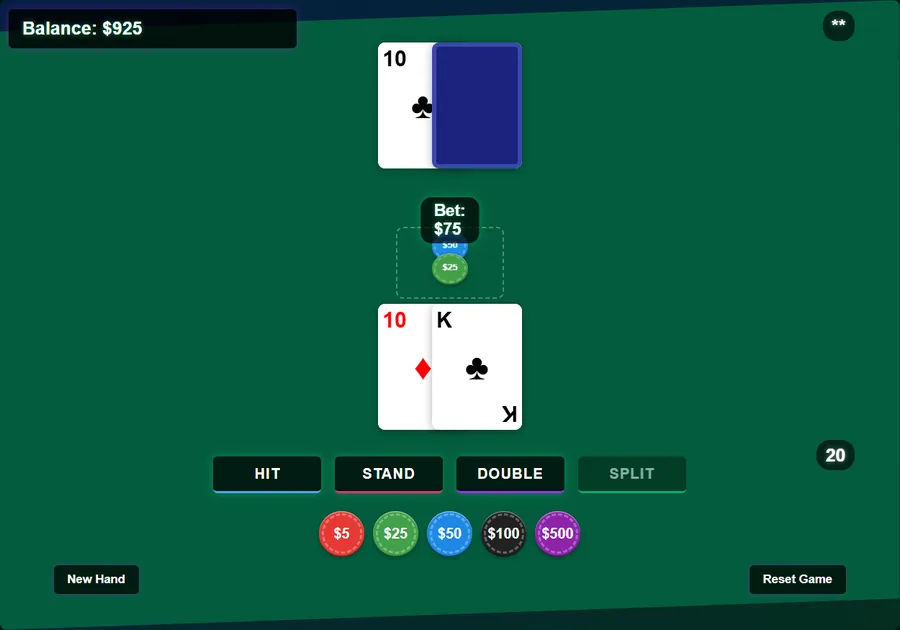
Drag a chip — $5, $25, $50, $100, or $500 — into the betting circle before the round starts; you can stack more than one chip to build a bet of any size up to your balance. Every new session of Blackjack starts you with $1,000 in play chips, no real money involved. Once a bet is placed, the Deal Cards button deals two cards to you and two to the dealer, with the dealer's second card face down.
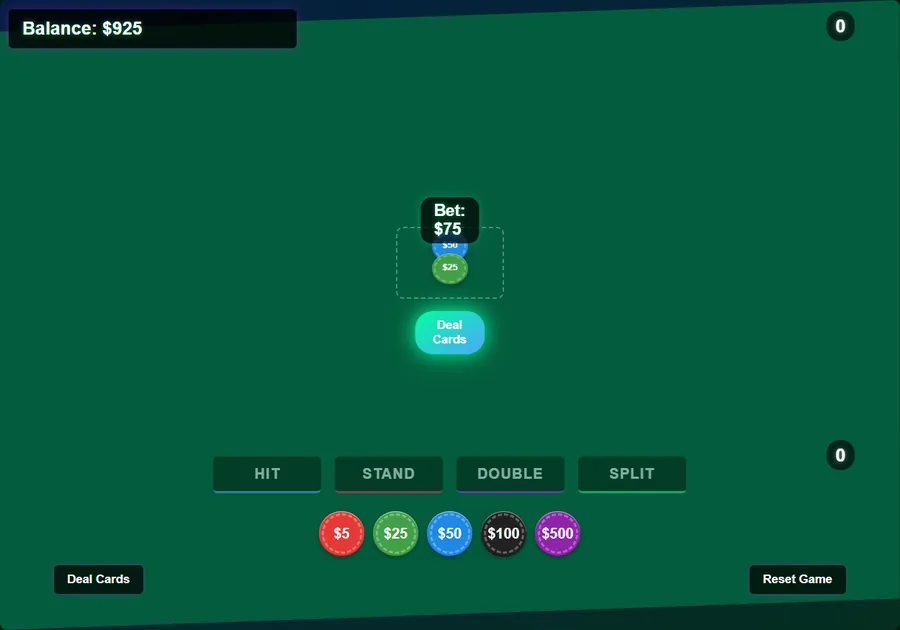
From there you choose an action on every turn of Blackjack:
- Hit — take another card.
- Stand — keep your current total and pass the turn to the dealer.
- Double — double your wager, take exactly one more card, and stand automatically.
There is no Split option in this build: the button exists on screen but is permanently disabled, and clicking it (when it briefly could be reached) only shows a "not implemented" message. If you're dealt a pair, you play it as an ordinary two-card hand — there's no way to break it into two hands here, which is the single biggest departure from a full-rules table and the reason this guide has no pair-splitting chart.
After you stand, bust, or double, the dealer flips the hidden card and draws under a fixed rule: hit on any total below 17, stand on 17 or higher — including a "soft" 17 made with an ace counted as 11. That's a player-friendlier rule than a dealer who hits soft 17, and it's baked into the code with no exception.
The Exact Rules Behind This Table
Every point below was confirmed by reading the game's own script, not assumed:
- One 52-card deck. The game builds a single standard deck (4 suits × 13 ranks) rather than a multi-deck shoe.
- Shuffle timing. The deck is not reshuffled after every hand. It's reshuffled only when fewer than 11 cards remain, checked right before a new hand is dealt — so the same deck typically serves several hands in a row before a fresh shuffle.
- Dealer stands on soft 17. The draw loop only checks the numeric total; there's no separate soft-17 rule, so any 17 or higher stops the dealer, soft or hard.
- Blackjack pays 3:2. A two-card 21 returns 2.5x your bet (your stake back plus 1.5x profit), unless the dealer also has a two-card 21, which is a push.
- No split, ever. The split button is hard-coded disabled.
- Double has no total restriction. Most physical casinos only let you double on totals like 9, 10, or 11. Here the only condition checked is that it's your first two cards and your balance covers the extra bet — you can double on a 4 or a 20 if you want to (though, as the numbers below show, you almost never should).
- No insurance, no surrender. Neither option exists anywhere in the code — no button, no state, no payout branch for either.
- No dealer hole-card peek. The game never checks the dealer's hidden card before you finish acting. That means if you hit or double into a dealer up-card that turns out to be a natural blackjack, you lose the full hit or doubled amount, not just your original bet — a real, measurable cost that a "peek" rule would remove, and one more reason to play Blackjack from the chart below rather than by feel.
- The dealer's blackjack only beats you by value. When the dealer turns over a two-card 21, the code compares totals like any other hand: your 20 or lower loses, but a 21 you built with three or more cards is a push, not a loss. Most real tables count the dealer's natural as an automatic win over any non-natural 21.
- A quirk worth knowing: the push-on-both-blackjack rule only fires when the dealer's 21 comes from exactly two cards. If the dealer reaches 21 by drawing a third card, your two-card blackjack still wins full 3:2 — the code compares totals normally in that branch instead of re-checking whether the dealer's 21 was "natural."
Basic Strategy Built From This Game's Code
Generic "blackjack strategy chart" pages online are built for a generic ruleset — usually a multi-deck shoe, sometimes a dealer who hits soft 17, and doubling restricted to 9-11. None of that matches this table exactly, so a copy-pasted chart is only approximately right here. Instead, this chart comes from a script that recreates this exact game: one 52-card deck drawn without replacement, dealer stands on all 17s, blackjack pays 3:2, and double is unrestricted. For every player total against every dealer up-card, the script recursively computes the exact expected value of standing, hitting, and doubling — accounting for every card still left in the deck — rather than guessing from a sample of simulated hands.
Read each table by finding your hand's row and the dealer's up-card column. H = hit, S = stand, D = double.
Hard Totals (no ace, or an ace that can only count as 1)
| Your total | 2 | 3 | 4 | 5 | 6 | 7 | 8 | 9 | 10 | A |
|---|---|---|---|---|---|---|---|---|---|---|
| 4-7 | H | H | H | H | H | H | H | H | H | H |
| 8 | H | H | H | D | D | H | H | H | H | H |
| 9 | D | D | D | D | D | H | H | H | H | H |
| 10 | D | D | D | D | D | D | D | D | H | H |
| 11 | D | D | D | D | D | D | D | D | H | H |
| 12 | H | H | S | S | S | H | H | H | H | H |
| 13 | S | S | S | S | S | H | H | H | H | H |
| 14 | S | S | S | S | S | H | H | H | H | H |
| 15 | S | S | S | S | S | H | H | H | H | H |
| 16 | S | S | S | S | S | H | H | H | H | H |
| 17-20 | S | S | S | S | S | S | S | S | S | S |
Soft Totals (an ace counted as 11)
| Your total | 2 | 3 | 4 | 5 | 6 | 7 | 8 | 9 | 10 | A |
|---|---|---|---|---|---|---|---|---|---|---|
| 12 (A-A) | H | H | H | D | D | H | H | H | H | H |
| 13-16 | H | H | D | D | D | H | H | H | H | H |
| 17 | D | D | D | D | D | H | H | H | H | H |
| 18 | S | D | D | D | D | S | S | H | H | H |
| 19 | S | S | S | S | D | S | S | S | S | S |
| 20 | S | S | S | S | S | S | S | S | S | S |
There is no pairs table because this version of Blackjack has no split action — a pair is just a two-card hand and falls into the hard or soft row that matches its total (a pair of aces is a soft 12, with one ace counted as 11, and has its own row in the soft table).
Where This Diverges From the Generic Chart
Three differences stand out. The freedom to double on any total barely matters in practice: the math still only rewards doubling on hard 8-11 and a narrow band of soft 13-19 hands against weak dealer cards — doubling a hard 12 or higher stays wrong even though the button allows it. The single 52-card deck also nudges a couple of borderline cells: soft 18 against a dealer's 2 favors standing here instead of doubling, and soft 19 against a dealer's 6 is one of the rare spots where doubling edges out standing — a known single-deck deviation that multi-deck charts don't show. And because there's no hole-card peek, doubling into a dealer's ace or 10 carries extra downside, which is why hard 10 and 11 stop being double-worthy against those two cards.
The House Edge on This Table
Running every possible two-card hand against every dealer up-card, weighted by how the 52-card deck actually depletes and playing the strategy above on every decision, the house edge is about 0.09% if you follow the chart above exactly, and 0.04% for a player who adjusts every decision to the precise cards already dealt. An independent simulation of 4 million hands with the chart agreed within its margin of error. That's unusually low for Blackjack. A single deck, a dealer who stands on soft 17, an uncapped double and the push against a three-card 21 all favor the player, while the missing split and the missing peek work against you. For scale, a table that pays blackjack at 6:5 instead of 3:2 costs the player about 1.4% on its own.
How to Bet in Blackjack Here
Betting is entirely chip-based: drag any of the five denominations into the circle before dealing, and the total updates live. There's no fixed table minimum coded in beyond having at least one chip down, and no maximum beyond your own balance. Two practical points from the code worth knowing before you play Blackjack for real chip stacks: the bet resets to zero after every hand — the game does not automatically re-bet your last amount — and once cards are dealt, the chip tray locks, so you can't add to a bet mid-hand outside of the Double action.
Card Counting: Does It Do Anything Here?
Counting tracks which high and low cards already left the shoe. Because this table reshuffles only when fewer than 11 cards remain — not after every hand — the deck composition does carry over between hands, which is the condition counting normally needs. It still changes nothing you can act on: bets are fixed once placed and the chips are fictional with no cash-out. Games that reshuffle before every hand make counting mathematically dead on arrival; this one merely makes it beside the point.
Frequently Asked Questions
How do you win at blackjack on this table?
Get a hand total higher than the dealer's without exceeding 21, or let the dealer bust. Standing on 17 or higher and following the hit/stand/double chart above for lower totals gives you the best mathematical shot, since the dealer here can't fold early or improve its odds beyond the fixed hit-below-17 rule.
How do you play blackjack for beginners on this specific game?
Place a bet with any chip, hit Deal Cards, and compare your two-card total to the dealer's single visible card. If your total is 8 or lower, always hit. If it's 17 or higher, always stand. Everything between those two follows the hard-totals table above.
How to play 21 if I've never used this table before?
"21" and "blackjack" are the same game here: the table auto-computes your total (treating aces as 11 unless that would bust you), shows it above your cards once dealt, and disables any button you can't legally use at that moment.
Can you split pairs in this version?
No. The Split button is visible but permanently disabled in this build — pairs play out as an ordinary hard or soft total instead of two separate hands.
Does the dealer check for blackjack before I act?
No. The hidden card is only revealed after you finish your turn, so doubling or hitting against a dealer showing an ace or a 10-value card carries the small extra risk of running into an unrevealed dealer blackjack.
How to bet in blackjack if I want to double down?
Double is only offered on your very first two cards, and only if your balance covers matching your original bet. Selecting it deals exactly one more card and stands you automatically — there's no way to hit again after doubling.
If you like this pace, try Poker Dice for a quicker chance-based round, or Computer Bingo for a numbers-based one. For more rule breakdowns like this one, browse the full guides index, or see how to play Connect Four and how to play Mahjong Solitaire. Every number above came from this table's own script, not a generic rulebook — open the chart and play a hand of Blackjack knowing exactly why each call is correct.