

Sudoku solving techniques form a ladder: naked and hidden singles first, then naked/hidden pairs or triples, then pointing pairs and box-line reduction, and finally X-Wing. Each rung below has a coordinate-based example (like r3c5, counted from the top-left) checked against a solver written for this guide, plus a full X-Wing walkthrough. The last section measures how far these techniques actually get you on Sudoku boards this site generates.
The Technique Ladder, From Simple to X-Wing
Work through these in order.
- Naked single - a cell with only one candidate digit left.
- Hidden single - a digit with only one legal cell left in a row, column, or block.
- Naked/hidden pairs and triples - two or three cells (or digits) locked together, letting you erase candidates elsewhere in the unit.
- Pointing pairs and box-line reduction - a digit confined to one line inside a block, or to one block inside a line.
- X-Wing - a digit locked into the same two cells across two rows or two columns.
- Where to stop - past X-Wing lies swordfish and forcing chains, which the measurements below show this site's own generator never actually demands.
Naked Singles: When Only One Number Fits
A naked single is a cell where its row, column, and 3x3 block have already used eight of the nine digits between them, leaving exactly one candidate. No pattern-spotting needed - just place it.
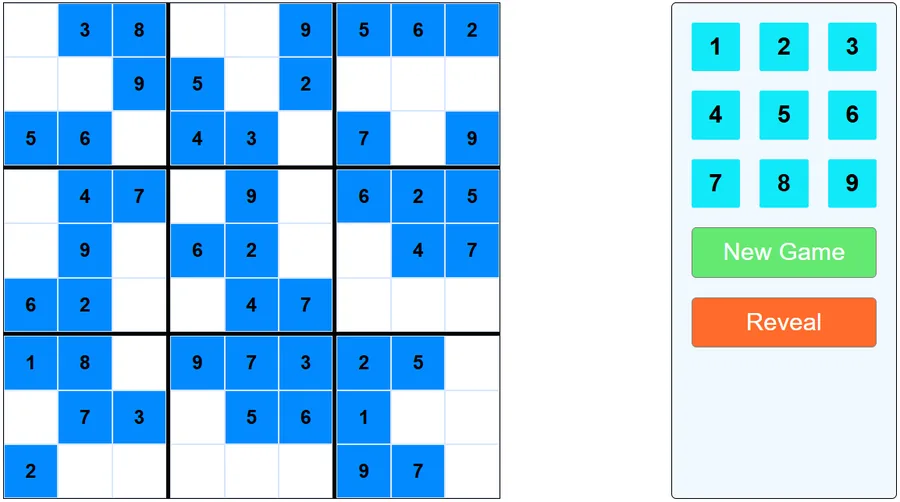
Verified example from a board generated on Sudoku: at r1c1, the row already held 3, 4, 5, 7, 8; the column held 2, 3, 5, 8; the block held 3, 6, 8, 9. Every digit except 1 was already used somewhere in those three units, so r1c1 had to be 1 - confirmed by the solver as the only candidate left, before any other move.
Hidden Singles: One Digit With Nowhere Else to Go
A hidden single looks different: the cell itself still shows several candidates, but one specific digit has nowhere else to go in the row, column, or block. You narrow the digit, not the cell.
On that same Sudoku board, r1c9 showed three raw candidates - 2, 6, 9 - before anything was placed. Row 1's other empty cells ruled 9 out: r1c2 could only be 1 or 2, r1c6 could only be 6. That leaves r1c9 as the only home 9 has in row 1, even though the cell "looked" ambiguous at a glance.
Naked Pairs, Hidden Pairs, and Their Triples
A naked pair is two cells in one row, column, or block whose combined candidates add up to exactly two digits. Neither cell is pinned down yet, but those two digits are locked between them, so both can be crossed off every other cell in that unit. A naked triple stretches the same idea to three cells and three digits. A hidden pair runs it in reverse: two digits that only ever appear as candidates in the same two cells of a unit - once spotted, every other candidate can be stripped from those two cells. Hidden triples extend that to three digits and three cells.
Verified example, built by trimming extra clues from this site's own solved grid and re-checking after every removal that exactly one solution remained: once singles ran dry, r8c4 and r8c5 held only {5, 7} between them. That naked pair let the solver erase 5 and 7 from the rest of row 8, including at r8c6. The same board held a hidden pair too: digits 1 and 4 turned out to be confined to r8c3 and r8c6 across that row, trimming both cells down to just those two digits.
Pointing Pairs and Box-Line Reduction
A pointing pair happens inside one 3x3 block: if a digit's remaining candidates there all sit in one row or column, the digit can be erased from the rest of that line outside the block. Box-line reduction runs the same idea backwards: if a digit's candidates in a full row or column are confined to one block, erase it from the rest of that block.
Verified example, same reduced board: inside the top-left block, digit 7's only remaining candidates sat at r2c3 and r3c3 - both in column 3. Since 7 must land in one of those two cells, it can't be anywhere else in column 3, so the solver erased it from r6c3, r7c3, and r8c3.
X-Wing: Closing Out the Ladder
X-Wing looks at two rows (or two columns) at once. If a digit is a candidate in exactly two cells of one row, and exactly two cells of a second row, and both pairs sit in the same two columns, that digit is trapped in those two columns for those two rows - it can't appear anywhere else in either column.
Full worked example, verified step by step, on a 26-clue board built the same honest way - extra clues stripped from this site's own base solution, one at a time, only kept when the puzzle still had exactly one answer:
- Scanning digit 5 across all nine columns, only column 1 and column 5 hold exactly two candidate cells each.
- Column 1's two candidates for 5 sit at r4c1 and r7c1. Column 5's sit at r4c5 and r7c5 - the same two rows, 4 and 7.
- That's the X-Wing: 5 must occupy rows 4 and 7 in one of those two columns each, so it can't appear anywhere else in either row.
- Every other candidate for 5 in those rows gets erased: r4c6, r7c2, and r7c3 lose 5 as an option.
- With 5 gone from r4c6, that cell has one candidate left - it resolves to 6, a fresh single created entirely by the X-Wing.
Past this rung sit swordfish and forcing chains, but as the numbers below show, this site's own Sudoku board almost never asks for anything past X-Wing - usually not even that far.
What This Site's Generator Actually Does
To see what kind of puzzles you actually get here, we ported the generator code from the live page into Python, line for line, and ran it 2,500 times through a solver that only knows the real rules of Sudoku.
- The clue count never changes. The generator clears exactly four cells from every one of the nine rows - 36 blanks, 45 clues, every time. There's no difficulty setting; New Game and Reveal are the only two controls besides the number keypad.
- The answer grid is shuffled every game. The fill step itself is a fixed backtracking order, so the game then swaps the nine digits for a random arrangement of 1 to 9. That keeps every row, column and block valid while giving 362,880 possible answer grids, on top of the random choice of which 36 cells are blanked.
- Uniqueness is never checked. After blanking cells, the generator never re-solves the board to confirm one answer still fits. Of our 2,500 generated boards, 1,161 - 46.4% - had more than one valid completion. Only 53.6% had exactly one.
That is why the win check in Sudoku here does not compare your grid with one recorded answer. It checks the rules instead: every row, column and block holding 1 to 9 once. If a board has two valid finishes, either one counts as a win.
Among the 53.6% of boards with exactly one solution, every single one in our sample - 100% - fell to naked and hidden singles alone. None needed pairs, pointing pairs, box-line reduction, or X-Wing; the worked examples above had to come from a deliberately clue-reduced version of the same base solution, because the live 45-clue boards never got hard enough to need them.
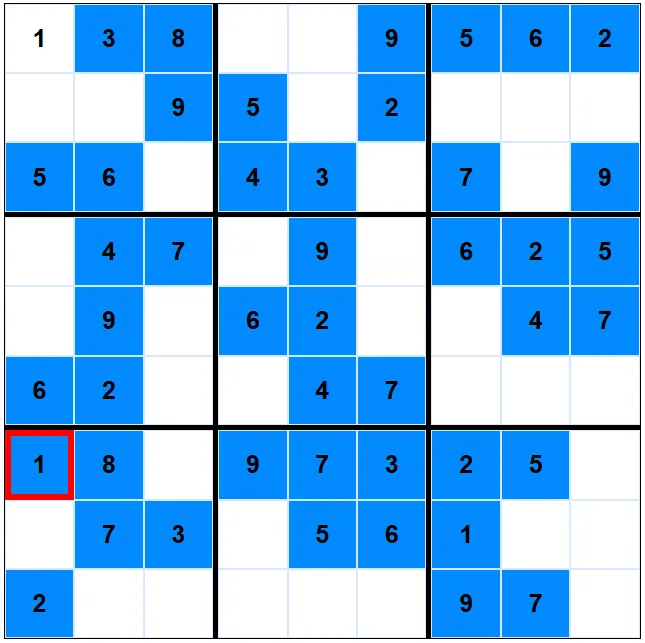
While you play, the game marks conflicts with a red border: place a digit that already sits in the same row, column or 3x3 block and the clashing cell is outlined in red. It flags rule breaks only. A digit that breaks no rule yet but leads to a dead end later gets no warning, which is exactly where the techniques above earn their keep.
One more mechanic worth knowing: Reveal isn't a hint. It blurs the board, counts down 30 seconds with a beep each second, then fills the entire grid at once from the recorded solution - not just your stuck cell - and skips the win check, so the congratulations popup never appears from using it.
Using the Ladder on This Site's Board
Tap a cell on Sudoku, then tap a number on the keypad below the board. Scan for naked and hidden singles first - that alone finishes the overwhelming majority of boards here. If you stall, look for a pair or pointing pair before reaching for anything heavier; X-Wing is worth knowing for other Sudoku you'll meet elsewhere, but this generator's own boards rarely demand it.
If you fill the whole board and the win popup does not appear, some row, column or block still repeats a digit. Look for the red border instead of re-reading all 81 cells; it points straight at the clash.
The same row-by-row, column-by-column elimination habit carries over to other logic puzzles here, like Minesweeper, where numbers around a tile narrow down where mines can be, or Nonogram, where row and column counts narrow down which squares get painted. See the full puzzle games list for more, or start with the beginner's guide to puzzle games if logic grids are new to you. The Minesweeper rules guide covers that elimination process in more detail.
Frequently Asked Questions
What's the first sudoku technique to learn?
Naked singles and hidden singles. Together they solved 100% of the boards this site's generator produced with a unique solution in our test, before anything else on the ladder was needed.
Do sudoku puzzles always have exactly one solution?
Well-designed ones do, because their generators re-check uniqueness after removing clues. Not every generator does: our 2,500-puzzle test of this site's own Sudoku found 46.4% of generated boards had more than one valid completion.
What comes after X-Wing?
Swordfish, XY-wings, and forcing chains extend the same elimination logic further. They show up in deliberately hard, hand-built puzzles far more than casually generated ones - our test found zero boards from this site's generator that needed even X-Wing.
Does the game tell me when I make a mistake?
It flags rule conflicts: a digit repeated in the same row, column or 3x3 block gets a red border as soon as you place it. It does not warn you about a digit that is legal for now but wrong for the final grid.
How many starting clues does this site's Sudoku give?
Always 45 on Sudoku, with 36 cells blank - four per row, every time, regardless of how many times you press New Game. There's no difficulty selector in the interface.
Does pressing Reveal count as winning?
No. Reveal fills the whole board from the recorded solution after a 30-second countdown, but skips the win check entirely, so the popup never appears from using it.