

Tower defense strategy comes down to three decisions repeated every wave: where you place a tower, what you spend on it, and when you upgrade it instead of building fresh. This guide covers the rules that hold across the genre, then applies them with exact numbers pulled from the code behind Elematter Tower Defense, the tower defense game on this site with a fixed path, four elemental tower types, and a currency called fragments.
Cover the Path, Not the Map
A tower's range is a circle, but the enemy route is a line. Only the arc where that circle overlaps the path matters, along with how long an enemy stays inside it. Two placements with identical range and damage can perform very differently: one that clips a straight stretch for a second, and one at a bend that keeps the same enemy in range across two separate legs of the route.
That's why tiles at corners and switchbacks are worth more than tiles on a long straight run, before you even look at a damage number. A tower at a turn taxes every enemy longer without spending an extra fragment on damage or fire rate. Find the corners first, then decide what to build there.
Damage Per Second Per Coin, Not Damage Per Tower
A tower that hits harder isn't necessarily a better buy. What matters for comparing towers or upgrade paths is damage per second divided by what you paid for it — DPS per unit of currency. A slow, expensive tower and a fast, cheap one can deal the same total damage over a wave, but one ties up far less of your budget doing it, leaving more currency free for the next choke point.
The trap is comparing raw damage-per-hit: a low number fired three times a second can beat a high number fired once every two seconds. Convert to DPS first, then divide by cost.
Economy: Don't Spend Faster Than You Earn
Any tower defense with a currency is really two games at once: the wave you're fighting, and the income curve you're building for the waves after it. Killing enemies is usually the main source of currency, so early waves are as much about banking it efficiently as surviving. Overspending on turn one can leave you unable to afford the tower that would have covered the second choke point — often the difference between a clean run and a life lost two waves later.
The practical rule: know your starting budget and the cheapest tower that covers your first choke point, and don't commit every coin to one powerful tower when two cheaper ones keep more of the path under fire.
Upgrade an Existing Tower or Build a New One?
This is the decision players get wrong most, confusing total damage output with damage per coin spent. Upgrading a tower always increases its damage, range or fire rate, but the fragments it costs are often less efficient, in DPS per coin, than the same fragments spent on a new base-level tower elsewhere. Upgrades buy quality at a single tile; a new tower buys coverage at a tile you don't have yet. The numbers below settle which one wins in Elematter Tower Defense, and by how much.
Applying It in Elematter Tower Defense
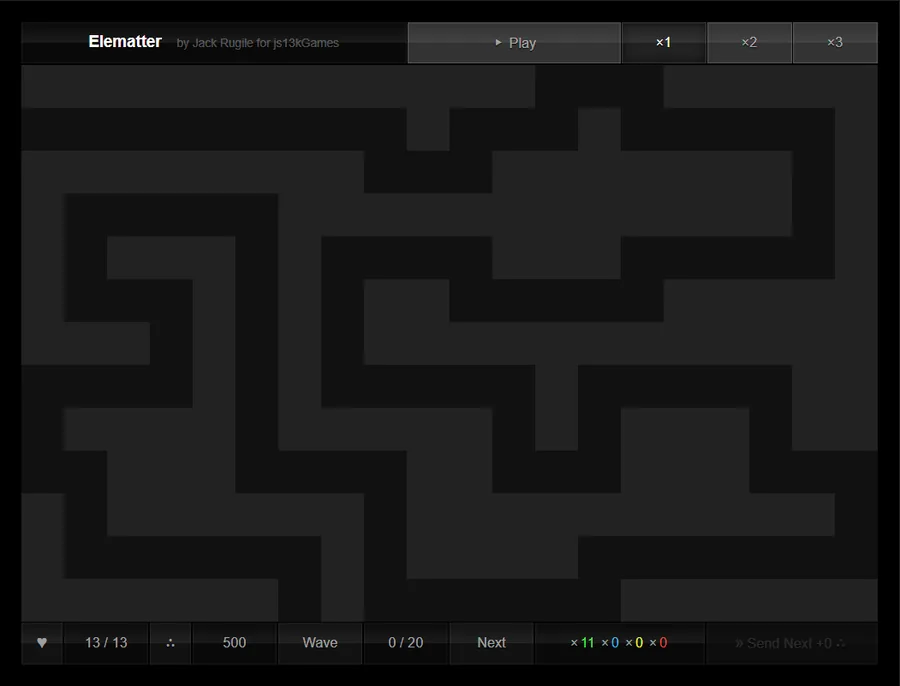
Elematter Tower Defense runs on an 800×600 canvas cut into 40px tiles (20 columns by 15 rows), with a single fixed path 41 waypoints long that measures 4,440 pixels end to end — 111 tiles of travel from spawn to base. You start with 500 fragments and 13 lives across exactly 20 waves. There is no maze-building: enemies always take the same route, so every decision is which tiles next to that fixed path to fill, and in what order.
Four elements, one damage cycle
The game defines four tower types — Earth, Water, Air and Fire — each with three levels. Every type deals +50% damage against one specific enemy type, and the bonus relationships form a closed loop: Earth counters Air, Air counters Water, Water counters Fire, and Fire counters Earth. Reading which element is heaviest in the wave counter before you build pays for itself the moment that bonus triggers.
Here is what each type and level actually costs and deals, computed straight from the tower data in the game's code:
| Tower | Level | Cumulative cost | Damage/hit | Shots/sec | Range (px) | DPS | DPS per fragment |
|---|---|---|---|---|---|---|---|
| Earth | 1 | 200 | 15 | 2.00 | 75 | 30.0 | 0.150 |
| Earth | 2 | 450 | 21 | 2.14 | 85 | 45.0 | 0.100 |
| Earth | 3 | 763 | 30 | 2.31 | 95 | 69.2 | 0.091 |
| Water | 1 | 300 | 15 | 2.40 | 65 | 36.0 | 0.120 |
| Water | 2 | 675 | 21 | 2.73 | 69 | 57.3 | 0.085 |
| Water | 3 | 1144 | 30 | 3.16 | 72 | 94.7 | 0.083 |
| Air | 1 | 250 | 10 | 2.00 | 85 | 20.0 | 0.080 |
| Air | 2 | 563 | 12 | 2.14 | 102 | 25.7 | 0.046 |
| Air | 3 | 954 | 14 | 2.31 | 121 | 32.3 | 0.034 |
| Fire | 1 | 250 | 20 | 1.71 | 75 | 34.3 | 0.137 |
| Fire | 2 | 563 | 33 | 1.82 | 85 | 60.0 | 0.107 |
| Fire | 3 | 954 | 55 | 1.88 | 95 | 103.1 | 0.108 |
Two things stand out. Earth at level 1 is the most fragment-efficient tower in the game at 0.150 DPS per fragment, making it the strongest opening buy regardless of which element the first wave favors. Air is the weakest by that measure at every level — its edge is range, not damage density, topping out at 121px, so it earns its tile at wide corners rather than tight chokes.
Upgrade or build fresh? The numbers say build fresh
Comparing a tower's level-1 DPS-per-fragment against the marginal DPS it gains per fragment spent on each upgrade settles this for every element:
- Earth: a new level-1 tower returns 0.150 DPS/fragment; upgrading to level 2 returns only 0.060, and upgrading to level 3 returns 0.077.
- Fire: a new tower returns 0.137; its upgrades return 0.082 and 0.110.
- Water: a new tower returns 0.120; its upgrades return 0.057 and 0.080.
- Air: a new tower returns 0.080; its upgrades return 0.018 and 0.017.
In every case, a brand-new level-1 tower adds more raw damage per fragment than the same fragments spent upgrading a tower you already have. That doesn't make upgrading pointless — a level-3 tower occupies one tile while pushing 69–103 DPS, and range grows with level too, Earth going from 75px to 95px, which matters when a single chokepoint tile is all you have. But for total DPS per fragment across the path, the code says spread fragments across new tiles before sinking them into upgrades on ones you've already built.
There's a floor cost to that plan: with the 500 fragments you start with, you can afford exactly two level-1 Earth towers (400 fragments) with 100 left over, or one Water tower and one Earth tower (500 exactly), or two Air/Fire towers (500 exactly) — but not three level-1 Earth towers, which would need 600. The math also tells you the fix: wave 1 alone pays out 330 fragments for its 11 kills, comfortably enough to fund that third tower before wave 2 arrives.
How fast the waves outgrow a starter defense
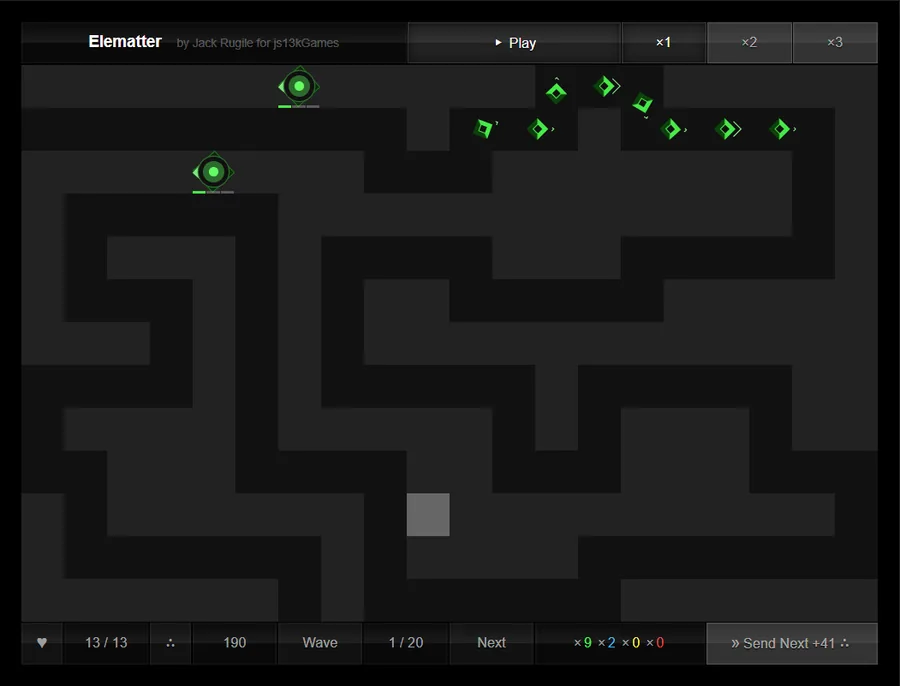
In Elematter Tower Defense, enemy health and speed scale with the wave number, and every fifth wave (5, 10, 15, 20) adds a boss with 20× the health and 3× the fragment reward of a normal enemy that wave. Running the wave data through the numbers above gives a hard ceiling on what a fixed defense can do. Suppose two level-1 Earth towers (60 combined DPS, 400 fragments, affordable from the starting stash) fired without a single pause for the whole 61.7 seconds that wave 5 spends on the 4,440px path. That is at most 3,700 damage, against 5,440 total hit points in the wave. Real towers only fire while an enemy is inside their range, so they land less than that ceiling, which means two starter towers cannot hold wave 5 no matter where you put them. With three level-1 Earth towers (90 DPS, 600 fragments), the same ceiling is first broken at wave 10: at most 4,593 damage in a 51.0-second crossing, against 11,800 hit points.
The practical read: by wave 5 at the latest, and again by wave 10, a starter defense needs real reinforcement. Those are the waves where even a perfect, never-idle version of it runs out of damage. In practice the squeeze comes earlier, because no tower covers the whole path.
If you'd rather compare a different tower roster and targeting model, Tower Defence Battle uses Basic, Sniper, Rapid Fire and Splash Damage towers instead of elements — a useful contrast for how a fixed-cost, fixed-damage set plays against Elematter's cost-scaling one. Space Defence applies the same wave-and-economy shape to base defenses built between countdown timers instead of towers on a path.
Putting It Together
Going into any run of Elematter Tower Defense with a plan beats reacting tile by tile: spend the opening 500 fragments on two or three level-1 towers at the tightest bends in the 111-tile route, favor Earth unless the matchup argues otherwise, and budget a real reinforcement, not just an upgrade, by wave 5 and again by wave 10. The wave counter under the build bar shows the next wave's elemental composition before it launches; that's the cue for what to build next.
The same rules carry into any other game in the Strategy category: find choke points before spending, compare towers by DPS per coin, keep income ahead of spending, and default to new coverage over upgrades unless one tile must do more work than one tower can. For turn-based planning without a wave timer, the Nine Men's Morris guide covers a different kind of position-and-tempo thinking, and the full guide library covers the rest of the catalog.
Frequently Asked Questions
What is the best tower to build first in Elematter Tower Defense?
Earth. At level 1 it returns 0.150 damage-per-second per fragment spent, the highest ratio of the four elements, and its 200-fragment cost lets you afford two of them from the 500-fragment starting stash.
Should I upgrade my tower or build a new one?
For raw damage per fragment, build new. Every tower type in Elematter Tower Defense returns more DPS per fragment from a fresh level-1 build than from any of its own upgrades. Upgrade instead when a specific tile, such as a corner with room for only one tower, needs more range or fire rate than a base-level tower provides.
Why did my defense suddenly stop working around wave 5 or wave 10?
Enemy health scales up every wave and jumps hard on boss waves (5, 10, 15, 20), where one enemy carries 20 times normal health. Two starter towers cannot deal 5,440 damage in the time wave 5 spends on the path even if they never stopped firing, and three cannot deal wave 10's 11,800. That is the wave-scaling formula in the code catching up to a static number of towers, and in real play the shortfall shows up a little before those waves.
Does tower placement matter more than tower choice?
Placement usually wins. A tower at a bend taxes enemies through two legs of the route for the same fragments as one on a straight stretch that only gets one. Pick tiles at turns before deciding which element goes on them.
What do the elemental counters actually do?
Each of the four tower types deals 50% more damage against the one enemy type it counters, and the relationship runs in a loop: Earth counters Air, Air counters Water, Water counters Fire, and Fire counters Earth. The wave counter display tells you what's coming so you can match the counter before the wave starts.
How much does reclaiming a tower refund?
Reclaiming refunds 75% of the total fragments you've put into that tower across every level, rounded up. A level-2 Earth tower that cost 450 fragments to build and upgrade refunds 338 fragments if you tear it down.