

Bingo rules boil down to one idea: mark the numbers on your card as they're called, and be first to complete the pattern your game requires. The two rule sets people mean when they say "bingo rules" are American 75-ball and British 90-ball. Computer Bingo on this site borrows the "match numbers against a random draw" core but runs its own scoring, and we tested exactly how with a 200,000-game simulation below.
75-Ball Bingo Rules (American Style)
75-ball bingo uses a 5x5 card with the letters B-I-N-G-O across the top. Each column only holds numbers from one range: B is 1-15, I is 16-30, N is 31-45, G is 46-60, and O is 61-75. The center square, in the N column, is a free space that counts as already marked. A caller (or a machine, in the digital version) draws numbered balls one at a time from a drum holding all 75 balls, and every player marks any number on their own card that gets called.
What ends the game depends on the pattern in play, announced before the round starts:
- Single line: any one full row, column, or diagonal of five marked squares (the free space counts toward it).
- Four corners: only the four corner squares of the card need to be marked — see the dedicated section below.
- Full card (blackout / coverall): every square on the card, all 24 numbers plus the free space, has to be marked. This is the slowest pattern and usually the biggest prize.
The first player to complete the announced pattern calls "Bingo" and the card is checked against the balls already drawn.
90-Ball Bingo Rules (British Style)
90-ball bingo uses a ticket, not a card: a 3-row by 9-column grid where each row holds exactly five numbers and four blanks, for 15 numbers per ticket. Numbers are grouped by column too — column one holds 1-9, column two 10-19, and so on up to column nine at 80-90. Balls are drawn from a full 1-90 set, one at a time, with no repeats.
90-ball games usually pay out in three stages, in order, during the same draw:
- One line: first player to mark all five numbers in any single row of their ticket.
- Two lines: first player to complete any two of the three rows.
- Full house: first player to mark all 15 numbers on the ticket. This is the main prize and the one most tickets are ultimately played for.
Because a ticket only has 15 numbers out of a 90-ball pool, the full house typically isn't decided until most of the balls have already been called — a pattern that, as it turns out, matches what we measured in this site's own Computer Bingo below.
How Computer Bingo On This Site Actually Works
Computer Bingo doesn't run either official rule set. It sits in the site's Board & Card lineup alongside games like Blackjack and Poker Dice, but its own rules are closer to a numbers race than to a card game. We read the game's own code to confirm exactly what it does, and it differs from both real bingo formats in every structural detail:
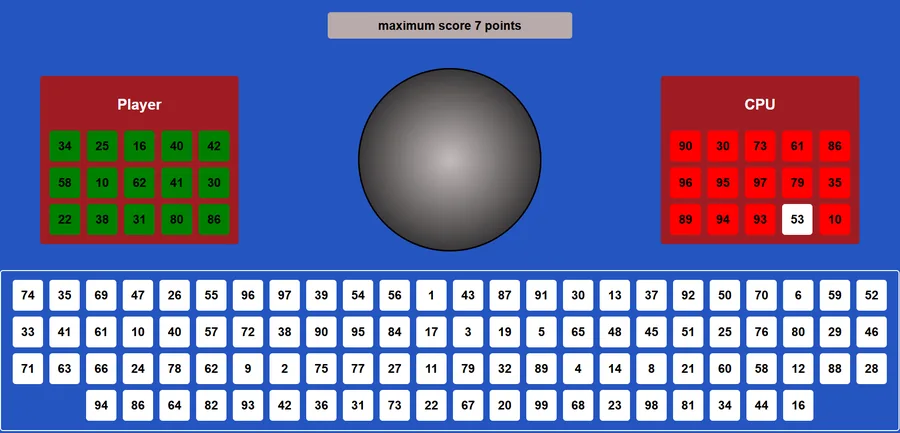
- The ball pool is 1-99, not 1-75 or 1-90. The script builds its drum from every integer 1 through 99 — 99 balls, drawn one at a time with no repeats.
- Each side gets 15 numbers, drawn independently. The player and the CPU are each dealt 15 unique numbers pulled from that same 1-99 range. The two cards are generated separately, so they can and do share numbers — there's no rule keeping the player's and the CPU's numbers apart.
- There's no card layout tied to number ranges. Unlike a 75-ball card's B-I-N-G-O columns or a 90-ball ticket's column bands, the 15 numbers on each side are just laid out in a plain grid (five across, three down) with no connection between position and value.
- Marking is fully automatic, on both sides, every single draw. In the version on this site, you never click a number on your own card to mark it. Every ball drawn is checked against the player's 15 numbers and the CPU's 15 numbers in the same step, and any match gets colored in automatically — green for the player, red for the CPU. The only clicks in the whole match are on the draw button itself and on the automatic-play toggle.
- Winning means covering all 15 numbers — a full house, not a line. There is no single-line win and no four-corner win in this version. The match ends the instant either side's count of matched numbers hits 15.
- The same ball can finish both cards. Because the two cards can share numbers, one ball sometimes completes the player's and the CPU's card at once. The game calls that a draw. We measured how often it happens below.
Two buttons control the pace: one draws exactly one ball per click, the other switches to a new ball every 300 milliseconds until you hit stop or someone wins. Both run the exact same matching function, so automatic play doesn't change your odds — only how fast you watch the draw happen.
The game also keeps a running best score in your browser's local storage, labeled "maximum score." That score is the number of balls still undrawn the moment the player wins — the faster your 15 numbers come up, the more balls are left over, and the higher the score. It only updates on a player win and never resets on its own.
We Simulated 200,000 Computer Bingo Matches
Because every rule above is verifiable in code, we ported the exact draw and win logic into a script and ran it 200,000 times to see what actually happens over a large sample, rather than guessing from a handful of rounds.
| Measurement | Result |
|---|---|
| Mean balls drawn before someone wins | 91.0 (out of 99) |
| Median balls drawn before someone wins | 92 |
| Chance the match is over within 50 balls | 0.00% |
| Chance the match is over within 75 balls | 2.09% |
| Chance the match is over within 99 balls | 100% |
| Player wins | 45.9% |
| CPU wins | 45.7% |
| Draw (both cards complete on the same ball) | 8.4% |
The biggest takeaway: this game almost never ends early. None of the 200,000 simulated matches were decided before the 48th ball, and the median match ran to ball 92 of 99 — essentially to the bottom of the drum. If you're several draws in with nobody near 15, that's normal; the game runs long by design.
The player and the CPU win almost exactly as often as each other, 45.9% against 45.7%, and the gap is within the noise of the simulation. That is what you would expect: both cards are dealt the same way and marked automatically, so there is no skill edge on either side. A surprisingly large share, about one match in twelve, ends in a draw because a single ball completes both cards at once.
The "maximum score" is rarer than it looks. Across every simulated player win, the balls-remaining count averaged only 7.6, and the single best result in the whole run was 48 balls left over, from a win completed in 51 draws. Beating your high score by a wide margin means catching a genuinely unusual run.
For context, we also simulated a single, unopposed 90-ball ticket chasing a real full house, same method, no rival card. That took a mean of 85.3 draws and a median of 87 out of 90 balls — nearly as long a wait as this site's two-card race, because covering 15 numbers out of a pool drives the length, not how many opponents are drawing.
Four Corners Bingo Rules
Four corners is a 75-ball pattern game, not a full-card game. Instead of waiting for a line or a blackout, players only need to mark the four squares in the corners of their 5x5 card — top-left, top-right, bottom-left, and bottom-right. Because only four squares are in play, four-corner rounds are one of the fastest 75-ball patterns to finish, which is why callers often run them as quick warm-up games or between bigger full-card rounds. The free center space has no role in a four-corner win since it isn't a corner.
Computer Bingo on this site does not offer a four-corner mode. As covered above, its only win condition is completing all 15 of your numbers — there's no way to win early by hitting a smaller pattern. If you specifically want a fast, pattern-based bingo round, that's a 75-ball hall or app feature, not something this browser game currently does.
Bingo Rules to Win
In a live 75-ball or 90-ball hall, the only lever a player controls is how many cards or tickets they play at once, since every marked square depends purely on which balls get called. More cards raise your chances of holding the winning one, but don't change the odds on any single card — and a missed number on a real card can cost a win the moment someone else calls it first.
None of that applies inside Computer Bingo, since marking is handled for you on every draw, on both sides — there's no card to misread and nothing to forget. The only real choices are drawing one ball at a time or switching on automatic play, and whether to keep chasing your best score. The simulation above sets the honest expectation: most wins land with single-digit balls left over, and anything past that is a lucky run, not a strategy.
Looking for other quick, luck-and-timing games on this site? Our guides on how to play Blackjack and the Eight Ball Pool rules cover two more head-to-head games against a computer opponent, and the full guides index lists every strategy page we've published.
Frequently Asked Questions
What are the basic rules of bingo?
Numbers are drawn one at a time from a fixed pool, and players mark any number on their card that matches. The first to complete the required pattern — a line, a set of lines, four corners, or a full card, depending on the variant — wins that round.
What's the difference between 75-ball and 90-ball bingo?
75-ball uses a 5x5 card with a free center space and column ranges under the letters B-I-N-G-O; typical wins are a line, four corners, or a full blackout. 90-ball uses a 3x9 ticket with 15 numbers and pays out in stages: one line, two lines, then a full house.
What are the four corners bingo rules?
Only the four corner squares of a 75-ball card need to be marked to win — no line, no blackout. It's one of the quickest patterns in 75-ball play because so few squares are required.
Does the Computer Bingo game on this site use official 75-ball or 90-ball rules?
No. It draws from a 1-99 pool instead of 1-75 or 1-90, deals both the player and the CPU 15 numbers independently (so their cards can overlap), marks matches automatically for both sides on every draw, and only ends when one side's full 15 numbers are covered — there's no line or four-corner win available.
How long does an average Computer Bingo match last?
In a 200,000-match simulation of the site's exact logic, the median match ran to ball 92 of 99, and no simulated match ended before ball 48. Matches essentially always run close to the bottom of the drum.
How do you win at bingo?
In a real hall, play more cards and mark accurately, since matching itself is luck-based. In Computer Bingo, marking is automatic for both sides, so the outcome is decided entirely by the random draw — the only choice left to the player is drawing manually or switching on automatic play.