

Poker Dice on this site rolls five ordinary six-sided dice — numbered 1 through 6, not card-faced dice — and asks you to fill 13 scoring categories over 13 rounds against a computer opponent. You get three rolls per turn, you can hold any dice between rolls, and whoever has the higher total after 13 rounds wins. Below are the exact odds for every hand, computed by enumerating all 7,776 possible single-roll outcomes, plus the dice-holding strategy that a full search of the game's own scoring rule found to maximize your expected score.
How a Turn Works in Poker Dice
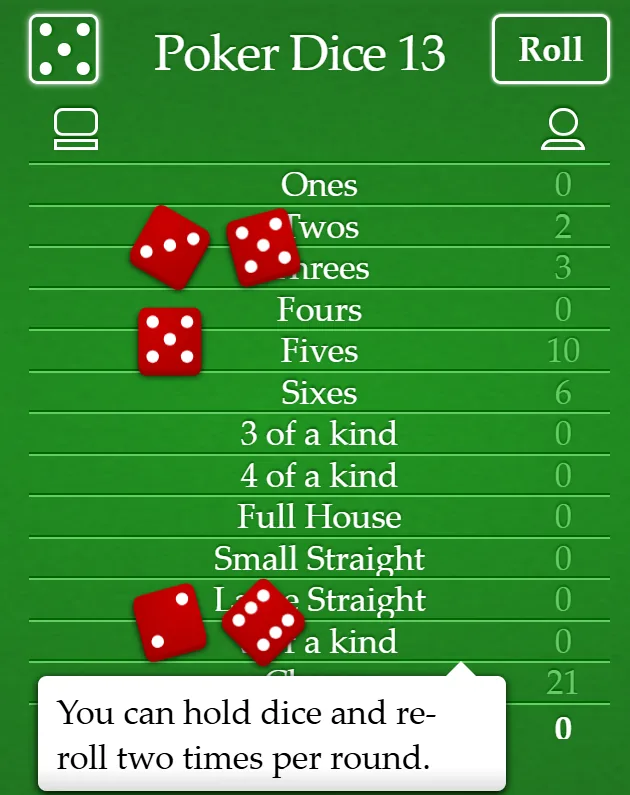
Every turn starts with a roll of five dice. Click any die to hold it — held dice keep their value and are skipped on the next roll, while every unheld die gets a fresh random 1–6 value. You get up to two re-rolls, three rolls total per turn, and you can stop early and lock a score at any point. After you pick a category, the turn passes to the computer, which plays its own three-roll turn using a recorded strategy. That's one round; the match runs 13 rounds per side, 26 turns total, with running totals for both sides sitting on the scoresheet the whole time.
There's no bluffing or betting in Poker Dice — each of the 13 categories gets filled exactly once by each player, and the only decision each turn is which dice to hold and which open category to use the result on. A tied total after round 13 ends the match in a draw.
The 13 Scoring Categories, Exactly as the Game Computes Them
The scoresheet lists Ones, Twos, Threes, Fours, Fives, Sixes, 3 of a Kind, 4 of a Kind, Full House, Small Straight, Large Straight, 5 of a Kind, and Chance — 13 boxes, one use each. Here is exactly how each one scores, taken directly from the scoring function:
| Category | How it scores | Notes |
|---|---|---|
| Ones through Sixes | Sum of only the dice showing that number | Always fillable, even for 0, if nothing else is better |
| 3 of a Kind | Total of all 5 dice | Needs at least three dice on one number |
| 4 of a Kind | Total of all 5 dice | Needs at least four dice on one number |
| Full House | Flat 25 points | Needs a three-of-a-kind AND a separate pair — a 4-and-1 split does not count |
| Small Straight | Flat 30 points | Any 4 consecutive values present; the 5th die can duplicate one of them |
| Large Straight | Flat 40 points | All 5 values consecutive, no duplicates |
| 5 of a Kind | Flat 50 points | All five dice show the same number |
| Chance | Total of all 5 dice | Always fillable, no requirement at all |
Two details are easy to miss just from playing. First, a small straight doesn't need exactly one of each of the four consecutive numbers — a duplicate filler die is fine, as long as all four values are present. Second, rolling a full 5-value run (1-2-3-4-5 or 2-3-4-5-6) qualifies for both Small and Large Straight at once, so you can bank the 30 now and still use the 40 slot later, or the reverse.
How This Differs From Traditional Poker Dice
In the version on this site, the "poker" in the name describes the shape of the hands you're chasing, not the dice themselves. Traditional poker dice sets replace the numbers with card ranks — 9, 10, Jack, Queen, King, Ace on each face, no suits — and a round is normally decided by the single best hand, ranked the way poker hands are ranked, with no running score across categories. This game instead uses standard numbered dice, a 13-round scoresheet with fixed point values per category, and a cumulative point total that decides the winner across the whole match rather than a single showdown. If you've played traditional poker dice before, treat the category names here (3 of a Kind, Full House, and so on) as a scoring label borrowed from poker, not a sign that the dice or the win condition work the same way.
The Exact Odds of Every Hand, From All 7,776 Rolls
Every one of the 65 possible ordered outcomes of five dice was enumerated once, scored with the game's own rule, and tallied. This is the probability that a given category is usable — meaning it scores above zero — on a single, un-re-rolled roll of five dice:
| Category | P(usable) on one roll |
|---|---|
| Any single number (Ones–Sixes) | 59.81% |
| 3 of a Kind | 21.30% |
| Small Straight | 15.43% |
| Full House | 3.86% |
| Large Straight | 3.09% |
| 4 of a Kind | 2.01% |
| 5 of a Kind | 0.08% |
| Chance | 100.00% |
A 5 of a Kind on the very first roll happens on only 6 of the 7,776 possible rolls: 0.08%. A raw Full House happens on 300 of them, a raw Large Straight on 240. None of that accounts for the two extra re-rolls every turn gives you, which is what actually matters for how you should play.
What Your Two Extra Re-Rolls Are Actually Worth
To measure what holding and re-rolling is worth, a script solves the full decision tree: for every possible set of five dice, and each of the two re-rolls left, it computes the expected score of holding every possible subset and re-rolling the rest, then picks whichever hold maximizes the expected final score — assuming, to isolate the holding decision, that all 13 categories are still open. That gives an expected score of 28.46 points per turn, and a 2,000,000-turn simulation playing out real rolls and holds under the same policy lands at 28.46 too, confirming the two methods agree.
The bigger story is how much the two re-rolls change your odds compared to a single raw roll:
| Category | P on 1 roll | P after a full turn, optimal holds |
|---|---|---|
| Small Straight | 15.43% | 54.56% |
| Large Straight | 3.09% | 19.94% |
| 4 of a Kind | 2.01% | 4.12% |
| 5 of a Kind | 0.08% | 0.93% |
| 3 of a Kind | 21.30% | 16.29% |
| Full House | 3.86% | 3.59% |
Small Straight availability more than triples by the end of an optimal turn, and Large Straight goes up sixfold. 3 of a Kind and Full House actually go down slightly under this policy — the search found that breaking an early pair to chase a straight beats keeping the pair and hoping it grows into a kind or a full house.
What to Hold When Every Box Is Still Open
The holds below come from that same full search, with all 13 categories open. That is exactly your situation on the first turn of a match, and roughly true for the first few. Once boxes start filling, the best hold changes, and this search does not cover that case.
- Even a pair of sixes is worth breaking to chase a straight. From 1-2-4-6-6 with two re-rolls left, the best hold is the 2 and the 4 (expected 26.2 points), not the sixes. The flat 30 and 40 of the two straight boxes outweigh a pair on an empty sheet.
- Two pair does not change that. From 2-2-4-6-6 or 2-2-4-4-6, the best hold is again a single 2 and a single 4.
- A made Small Straight with a spare duplicate should chase the Large Straight. Keeping the four-value run and re-rolling only the duplicate raises the expected score from a flat 30 to 33.1 for 1-2-3-4 and 35.6 for 2-3-4-5, since one right die turns it into 40.
- 4 of a Kind should keep all four and re-roll the fifth die (expected 28.8). The fallback total is already good, and the fifth die is a free shot at 50.
- A made Full House is only barely worth breaking. From 5-5-5-2-2, re-rolling the pair while keeping the three 5s is worth 25.99 against a guaranteed 25. The margin is small enough that taking the 25 costs almost nothing.
- With an empty sheet, the search breaks up even three of a kind. From 1-3-5-5-5 it keeps one 3 and one 5 and re-rolls the rest. Treat that as a first-turn rule only: it comes from the straight boxes being open, not from the 5s being worthless.
What the Computer Opponent Remembers Between Games
The computer in Poker Dice doesn't calculate moves live — it replays one of 13 pre-recorded games, picked at random when a match starts. That roster isn't fixed forever: if you finish a full 13-round match with a total over 150 points, the game overwrites the AI slot used in that match with a recording of your own rolls and holds, and saves the updated roster to the browser's local storage. A strong session can permanently replace one of the computer's 13 "personalities" with a copy of how you played, and it persists the next time you open the page, even after closing the browser.
Session stats — games played, wins, your best total, and 5-of-a-Kind count — are tracked separately and reset when the browser session ends. Your win count from last week won't be there; the AI's memory of a strong match will.
A Few More Things Worth Knowing Before You Play
Chance always accepts any roll, which makes it the natural place to dump a bad final roll instead of zeroing out a fixed-value slot. Because 3 of a Kind and 4 of a Kind both score as the sum of all five dice, a kind on high numbers can beat a mediocre straight once your straight slots are already filled — the strategy above assumes every category is open, so which hold is "correct" shifts once your real scoresheet starts filling in during a 13-round match. Hold for straights early in a game of Poker Dice, since Small and Large Straight gain the most from a second and third roll, and save Chance and the number rows for whichever turn gives you nothing better.
If category-scoring dice games like this one are your thing, this site also has rule-and-strategy pages for other board and card guides, including how to play Blackjack, 8 Ball Pool rules, and the rules and strategy for Nine Men's Morris.
Frequently Asked Questions
Is this Poker Dice the same as traditional poker dice?
No. Traditional poker dice use card-faced dice (9, 10, J, Q, K, A) and a single best-hand showdown. This game uses standard numbered 1–6 dice, three rolls per turn, and a 13-round, 13-category running score against a computer opponent, as described above.
How many dice do you roll in Poker Dice?
Five. Every roll and every re-roll in Poker Dice works with the same five dice; held dice keep their value and unheld dice get a new random 1–6 value.
What is the best hand in Poker Dice?
5 of a Kind, worth a flat 50 points, is the highest-scoring category on the sheet. It also happens to be the rarest hand — it appears on only 0.08% of raw single rolls and about 0.93% of the time even after a full turn played with the score-maximizing hold strategy.
What counts as a straight in this game?
Any four consecutive numbers among your five dice count as a Small Straight (30 points); the fifth die can be a duplicate of one of the other four. All five dice landing on five consecutive numbers, with no duplicates, counts as a Large Straight (40 points) and also satisfies the Small Straight requirement at the same time.
How many rolls do you get per turn?
Three: your first roll, plus up to two re-rolls of whichever dice you haven't held. You can also stop after the first or second roll and lock in a score early if you're happy with what you have.
Does the computer opponent get harder over time?
It can change, though not by getting "smarter" in real time — it replays one of 13 recorded games. If you beat it soundly (a match total over 150), that recorded game gets replaced with a copy of your own play and saved in the browser, so the pool of opponents you might face later can include a version of a strong match you played yourself.